All of the police and crime commissioner elections have been counted, including the mega one for the capital city. The only exceptions being Northern Ireland and Greater Manchester (for different but special reasons).
In other words, while everyone has been poring over the local government elections, looking for indications as to how the results transfer onto the national scene, almost everyone appears to have forgotten the PCC elections that happened across the England and Wales. We have a great deal of useful data here that gives an indication of how national parties are fairing in the eyes of the electorate now and in comparison to four years ago.
Over the course of a few furrowed hours, I have pulled together this spreadsheet of data provided by Policing Insight which seeks to analyse the Conservative/Labour dimension of the PCC elections. I am not an expert psephologist and it is also quite possible that there are one or two glitches in the data (please email me if you spot one: thanks). I have only used first preference figures, as these most closely mirror voting in a general election. And of course, it should go without saying that PCC elections are odd beasts, although given the results of last week, I think they are becoming less odd...
But here are some conclusions I can draw:
In 2012, the Labour share of all the PCC (including London Mayor) votes was 33.92%. The Conservative share was 33.14%. Note the Conservative share was only slightly less that the Labour one. Perhaps in hindsight this was a portent to the general election result in 2015?
What about now? The Conservative share is down to 30.59%, a drop of over 2.5%. The Labour share on the other hand is up to 36.64%, a gain of over 2.5%. The gap between the two is now running at over 6%.
Interesting huh?
It is also worth noting that in the 41 PCC elections contested, 25 Labour and 25 Conservative candidates increased their share of the vote between 2012 and 2016.
There are now 20 Conservative PCCs, 2 Plaid Cymru, 3 Independent and 17 Labour (including Greater Manchester). Interestingly the number of votes cast last week overall for Labour and Conservative were 1,148,716 and 909,715 respectively. So nearly a quarter of a million more votes for Labour but four fewer PCCs.
Much more will be written about the PCC elections I am sure: including why only three independent PCCs survived and only in the South West. And how will the new make-up of the collective body of PCCs change matters in the future.
I watch this space.
Monday, May 9, 2016

Thursday, April 7, 2016
Clearly a contemporary campaign
Anthony Stansfeld is evidently pulling out all the stops in his campaign to be re-elected as PCC for Thames Valley. He has relaunched his campaign website which is filled with stock national news items from Conservative Party HQ.
The other local news items are... maybe a tad out of date?


The other local news items are... maybe a tad out of date?

I will be keeping my eyes on his website to see new news emerges as his campaign steams into action
Meanwhile, who am I to talk? My personal campaign against his re-election is a tad old news as well:

... or is that old news?
Saturday, April 2, 2016
So Mr Stansfeld, we meet again...
So it is now evident that the incumbent Police & Crime Commissioner for Thames Valley is really standing for re-election. I could not quite believe it to be true until a local conservative councillor tweeted this earlier on today:
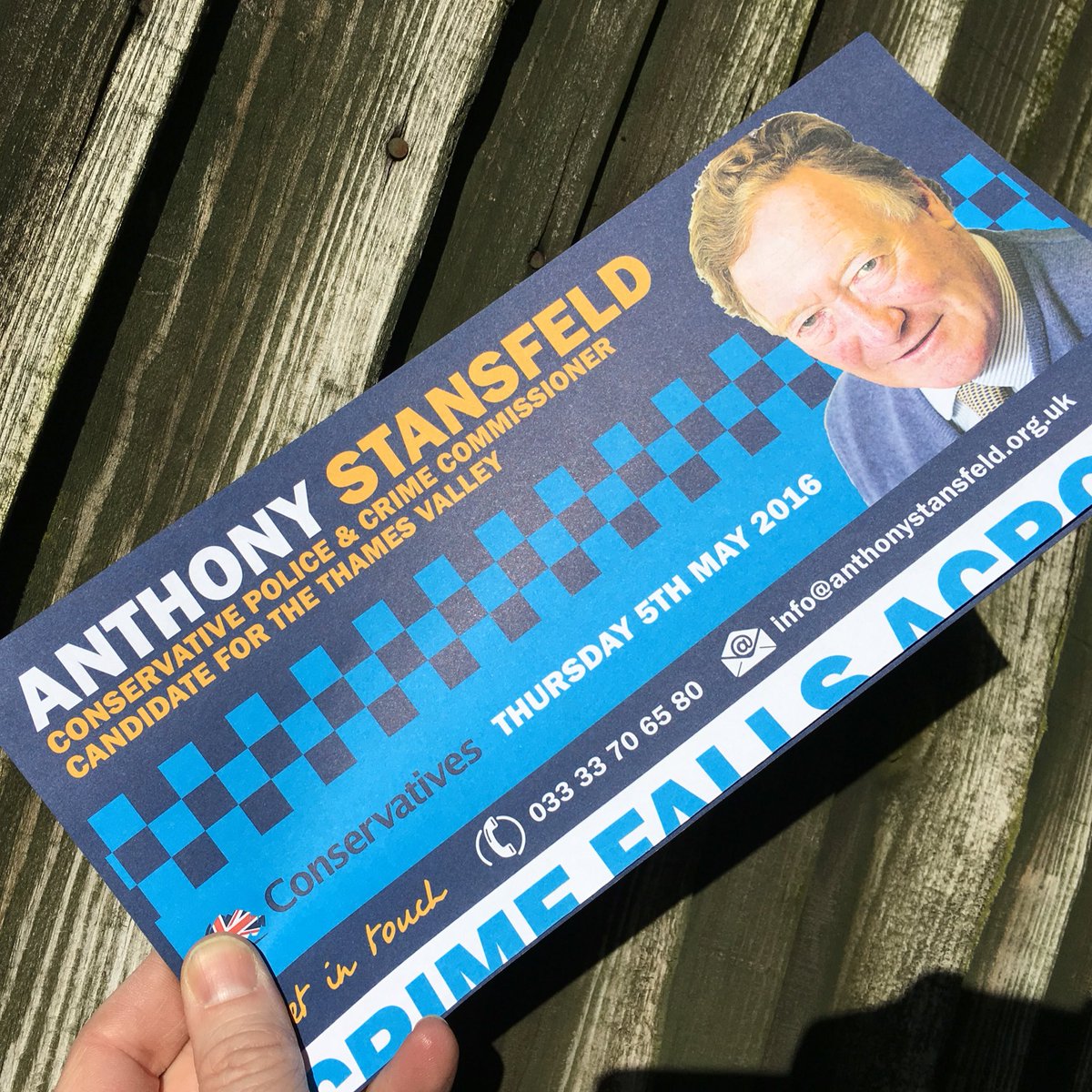
Early in his time as PCC, Mr Stansfeld indicated that he was unlikely to stand again, although he did not rule it out. So it is interesting that he has chosen to do so... I wonder why.


@CllrWarrenWhyte
Helping to deliver some #PCC2016 @Conservatives election literature. @BuckinghamBlue @MKConservatives #5May
Early in his time as PCC, Mr Stansfeld indicated that he was unlikely to stand again, although he did not rule it out. So it is interesting that he has chosen to do so... I wonder why.
Especially when he has such headlines as these still hanging around:
£85,000 crime tsar used sham office to hike expenses 6,000% (and he's the first Police Commissioner to hire a chauffeur as well)Is this water under the bridge or will this come back to haunt him. Readers might be interested to read his statement that he read out to the Police & Crime Panel following the publication of this story:


Note his words carefully, especially these:
The Thames Valley is huge, it is the largest non metropolitan police force in the country. To drive across it and back is nearly 150 miles. Much of my time is spent in a car travelling from one end to the other. I was driving over 500 miles some weeks. To do this, attending meetings, often chairing them, giving speeches, making presentations, finding my way, looking for car parking in towns I was not familiar with became downright dangerous. I was overtired and wasting a huge amount of my time driving that could be better used.
I am well into my state pension, if I was 30 years younger this pace might be possible. If I have a medical issue, drop dead or injure myself, the bill to replace me will be into the millions. Having a support officer who can drive is a wise investment and insurance policy.
Are these the words of a man, from three years ago, that you would have confidence in for the next four years?
Maybe it's time to dust off my chauffeur's cap...?
PS Thames Valley is the largest non met police force by budget and police numbers - it is not the biggest geographically by a long chalk. the PCCs for Dyfed-Powys and Devon & Cornwall have many more miles to cover.
Saturday, January 16, 2016
The party conversation that confirms it (Secret PCC)
Picture the scene: Saturday evening drinks at my wife's cousin's place. Slim glass of pop in hand, cheese & chutney sandwich in the other (again)...
Me: Harry, my old sport, how the dashed are you?
Harry: Fine old chum. What you up to these days?
Me: I'm still running the police.
Harry: Still running from the police?! You're not that Basil chap are you? Got all those jewels stuffed inside your teapot?
Me: No. I am still running the police. You know, you helped me deliver some leaflets a few years ago. I'm the Police & Crime Commissioner.
Harry: The what?
Me: Single-handedly I am responsible for administering the governance of the Police Service here in North Ford West Shire.
Harry: Sounds very grand. Do you get expenses with that? And have you got one of those detachable blue lights to stick to the top of your car when you need to get home a bit quicker...? You say I helped you deliver leaflets... hmm... I thought that was for a council position. All lost in a bit of blur, I am afraid. So you won then?!
Me: Yes.
Harry: So is that it? Are you this police thingamajig for good now? You know like that chap Scargill: President of the Police for life?
Me: No. There are elections in May. I am trying to decide whether to stand again...
Harry: You want more leaflets delivered?
Me: I don't think so. I am probably not going to stand again...
Harry: Why not. Are the expenses no good? Didn't you have a chauffeur?
Me: Gordon is my coach who happens to drive me places. He's a wonder. But no, that's not the reason..
Harry: Well what is the reason then?
Me: I am not sure I can take the starlight of celebrity much longer, the being mobbed in the streets by people desperately wanting to talk to me about policing strategy, the flash photography outside the Home Office, the paparazzi at my home...
Harry: Gosh!
Me: I am being sarcastic Harry. I don't think most people even know I exist...
Harry: I know you exist, old bean. Don't talk like that. I am sure what you do makes a real difference. Now I must go and get myself one of those cheese and chutney sandwiches: they look rather tasty if a little bit tricky to handle...
_________________________________________________
Me: Harry, my old sport, how the dashed are you?
Harry: Fine old chum. What you up to these days?
Me: I'm still running the police.
Harry: Still running from the police?! You're not that Basil chap are you? Got all those jewels stuffed inside your teapot?
Me: No. I am still running the police. You know, you helped me deliver some leaflets a few years ago. I'm the Police & Crime Commissioner.
Harry: The what?
Me: Single-handedly I am responsible for administering the governance of the Police Service here in North Ford West Shire.
Harry: Sounds very grand. Do you get expenses with that? And have you got one of those detachable blue lights to stick to the top of your car when you need to get home a bit quicker...? You say I helped you deliver leaflets... hmm... I thought that was for a council position. All lost in a bit of blur, I am afraid. So you won then?!
Me: Yes.
Harry: So is that it? Are you this police thingamajig for good now? You know like that chap Scargill: President of the Police for life?
Me: No. There are elections in May. I am trying to decide whether to stand again...
Harry: You want more leaflets delivered?
Me: I don't think so. I am probably not going to stand again...
Harry: Why not. Are the expenses no good? Didn't you have a chauffeur?
Me: Gordon is my coach who happens to drive me places. He's a wonder. But no, that's not the reason..
Harry: Well what is the reason then?
Me: I am not sure I can take the starlight of celebrity much longer, the being mobbed in the streets by people desperately wanting to talk to me about policing strategy, the flash photography outside the Home Office, the paparazzi at my home...
Harry: Gosh!
Me: I am being sarcastic Harry. I don't think most people even know I exist...
Harry: I know you exist, old bean. Don't talk like that. I am sure what you do makes a real difference. Now I must go and get myself one of those cheese and chutney sandwiches: they look rather tasty if a little bit tricky to handle...
_________________________________________________
The Secret PCC Diary until now:
Legal disclaimer: just in case you thought this series of secret PCC blogs is based upon a real person or persons: it isn't. It really isn't. Any similarity to a living PCC is entirely coincidental.
- Collected diary - days one to ten
- Day 50
- Day 68
- Appointing the new Chief Constable
- PCCs must show people its worth voting (interview with the secret PCC)
- Fields of ponies: the Secret PCC does Income Generation!
- By the pricking of my thumbs, something radical this way comes!
- Too big for their pixie boots: the Secret PCC makes a speech to his Police & Crime Panel
- Witchcraft: the Secret PCC & managing awkward Chiefs
- Social media policy (Secret Diary of a PCC)
- The magic of Brasso (Secret diary of a PCC)
- The 'not giving a floating duck' problem (Secret Diary of a PCC)
- Secret PCC: A LibDem MP considers applying for Direct Entry
- Chief Constable Zero: the Secret PCC gets tough
- The Art of Listening to the Public (the Secret PCC explains all)
- Secret PCC: my life long quest for the smooth vinegar flavoured cucumber
- The Glossary: The Secret PCC is relieved
- Sepia policing: the Secret PCC hankers for the wild west
- Plebian correctness gone mad: the Secret PCC develops new ethical guidelines
- The Secret PCC: should I stand again?
Legal disclaimer: just in case you thought this series of secret PCC blogs is based upon a real person or persons: it isn't. It really isn't. Any similarity to a living PCC is entirely coincidental.
Friday, January 15, 2016
The Secret PCC: should I stand again?
Well, well, well.
It has been a long three and bit years. In a way, it has gone by as quickly as a South African innings. And here we are, in the run up to the May elections which frankly I thought I would not have to think about. But against predictions, the Tories won a majority and now I am stuck with having to make a decision on whether to stand again. So I thought I would do a balance sheet, working through all the pros and cons to help me decide...
On the plus side:
The power.
The power!
The unaccountable powerrrr! (I like to delude myself sometimes) I think I may have some smidgeon of influence over the colour of the cells in the new custody suite that I commissioned. I say I commissioned... but the plans were pretty already drawn up by the time I arrived.
But on the down side:
I have seen enough sandwich lunches to last me and my waistline a lifetime. I have become quite an expert in holding cheese and chunky chutney sandwiches and a glass of orange juice, without spilling the chutney down my suit. It's a rare skill but one I have now perfected. But do I want any more sandwiches... ever?
The bounciness of senior coppers has to be seen to be believed. Honestly, it is so bloomin' tiring. They are like chipmunks on speed. Always some new strategy for this. Partnership plan for that. Yet another power point presentation on some whizzo idea they picked up on their trip to the police department in Oklahoma. I could well have had enough...
Partnership meetings. Oh good grief. What can you say about them except that I might like to spend some of my retirement watching paint dry. It would be more entertaining. And interesting. I used to have partnership zeal: they were the future! But now I only have partnership weal: proto pressure sores from sitting too long in these tedious meetings, massaging the egos of different heads of this or that.
And then there's the Police and Crime Panel. I think I am going to do a PhD in nit nit picky picky pettiness: I now indeed, do have plenty of material. Try as I might to keep them focused on me (yes me!) they still insisted on trying to hold the Chief Constable to account. Even though I told them until I was blue in the face that was my job... they still wanted to scrutinise the decisions on the new siren sounds and colour of the cells in the new custody suite...
Hmm. I think I have made my decision... I will miss the team of course: my chief executive, my aromatherapist, my astrological adviser, my part time press adviser and Gordon, my trusted coach and chauffeur. What could I have done without him...!
So, now I have start making my plans for my last 100 days... what will I need to do?
_________________________________________________
It has been a long three and bit years. In a way, it has gone by as quickly as a South African innings. And here we are, in the run up to the May elections which frankly I thought I would not have to think about. But against predictions, the Tories won a majority and now I am stuck with having to make a decision on whether to stand again. So I thought I would do a balance sheet, working through all the pros and cons to help me decide...
On the plus side:
The power.
The power!
The unaccountable powerrrr! (I like to delude myself sometimes) I think I may have some smidgeon of influence over the colour of the cells in the new custody suite that I commissioned. I say I commissioned... but the plans were pretty already drawn up by the time I arrived.
But on the down side:
I have seen enough sandwich lunches to last me and my waistline a lifetime. I have become quite an expert in holding cheese and chunky chutney sandwiches and a glass of orange juice, without spilling the chutney down my suit. It's a rare skill but one I have now perfected. But do I want any more sandwiches... ever?
The bounciness of senior coppers has to be seen to be believed. Honestly, it is so bloomin' tiring. They are like chipmunks on speed. Always some new strategy for this. Partnership plan for that. Yet another power point presentation on some whizzo idea they picked up on their trip to the police department in Oklahoma. I could well have had enough...
Partnership meetings. Oh good grief. What can you say about them except that I might like to spend some of my retirement watching paint dry. It would be more entertaining. And interesting. I used to have partnership zeal: they were the future! But now I only have partnership weal: proto pressure sores from sitting too long in these tedious meetings, massaging the egos of different heads of this or that.
And then there's the Police and Crime Panel. I think I am going to do a PhD in nit nit picky picky pettiness: I now indeed, do have plenty of material. Try as I might to keep them focused on me (yes me!) they still insisted on trying to hold the Chief Constable to account. Even though I told them until I was blue in the face that was my job... they still wanted to scrutinise the decisions on the new siren sounds and colour of the cells in the new custody suite...
Hmm. I think I have made my decision... I will miss the team of course: my chief executive, my aromatherapist, my astrological adviser, my part time press adviser and Gordon, my trusted coach and chauffeur. What could I have done without him...!
So, now I have start making my plans for my last 100 days... what will I need to do?
_________________________________________________
The Secret PCC Diary until now:
Legal disclaimer: just in case you thought this series of secret PCC blogs is based upon a real person or persons: it isn't. It really isn't. Any similarity to a living PCC is entirely coincidental.
- Collected diary - days one to ten
- Day 50
- Day 68
- Appointing the new Chief Constable
- PCCs must show people its worth voting (interview with the secret PCC)
- Fields of ponies: the Secret PCC does Income Generation!
- By the pricking of my thumbs, something radical this way comes!
- Too big for their pixie boots: the Secret PCC makes a speech to his Police & Crime Panel
- Witchcraft: the Secret PCC & managing awkward Chiefs
- Social media policy (Secret Diary of a PCC)
- The magic of Brasso (Secret diary of a PCC)
- The 'not giving a floating duck' problem (Secret Diary of a PCC)
- Secret PCC: A LibDem MP considers applying for Direct Entry
- Chief Constable Zero: the Secret PCC gets tough
- The Art of Listening to the Public (the Secret PCC explains all)
- Secret PCC: my life long quest for the smooth vinegar flavoured cucumber
- The Glossary: The Secret PCC is relieved
- Sepia policing: the Secret PCC hankers for the wild west
- Plebian correctness gone mad: the Secret PCC develops new ethical guidelines
Legal disclaimer: just in case you thought this series of secret PCC blogs is based upon a real person or persons: it isn't. It really isn't. Any similarity to a living PCC is entirely coincidental.
Thursday, December 31, 2015
Child protection review
It has been a while since I posted here: other writing has taken precedence, not least my forthcoming book on improving productivity and efficiency. But watch this space as we run up to the PCC elections in May...
Meanwhile I continue to volunteer for ChildLine: delivering workshops to 8/9/10 year olds on staying happy and safe. This means I get sent regular updates from the NSPCC on their work. I have just received this email which lists an impressive year of action by the charity in support of children leading happy lives, free from fear.

Meanwhile I continue to volunteer for ChildLine: delivering workshops to 8/9/10 year olds on staying happy and safe. This means I get sent regular updates from the NSPCC on their work. I have just received this email which lists an impressive year of action by the charity in support of children leading happy lives, free from fear.
January
We launched Share Aware, our campaign aimed at parents of 8-11 year olds, to give parents ‘no-nonsense’ advice about social media networks and keeping children safe online. This included a new tooldeveloped in partnership with Mumsnet, which is a guide to the social networks, apps and games that children use including reviews and quotes from children and young people themselves. As part of the campaign one of our new animated films ‘I Saw Your Willy’ had over two million hits over social media.
February
Justice Lowell Goddard was named as Chair of the Home Office Inquiry into Child Sexual Abuse. In a statement Peter Wanless commented on the appointment. Justice Goddard later said that internet firms will be called to the child sex abuse inquiry to explain what more they could do to tackle child porn. In a statement covered on the Mail Online we said: “There are clear links between accessing this horrendous material and contact offending. This vile trade needs to be tackled as a priority. These are not just images – they portray the agony of a real child being abused and to all intents and purposes are crime scenes.”
Our new service Women as Protectors was launched in York, Croydon and Belfast. The service is for women whose husband or partner has sexually abused a child or children, which can lead to feelings of isolation and being concerned about the safety of their children. Previously, support hasn’t been widely available, recovery plans often focus only on the person who poses a risk and women’s needs can be side-lined. That can have a damaging effect on her ability to protect her children, leaving them at risk of sexual abuse.
March
We launched our ChildLine campaign, FAPZ (Fight Against Porn Zombies), dealing with the growing issue of online pornography. A UK-wide survey of 2,000 children revealed that nearly one in ten 12-13 year olds are worried they are addicted to porn, and the campaign raised awareness and provided advice to young people. The campaign illustrated that online porn does not reflect real life, and worked to build young people’s resilience towards online porn
April
The Virgin Money London Marathon took place, with many people taking part in support the work of the NSPCC and ChildLine receiving mentions in regional news outlets across the country. We officially announced our partnership as charity for next year’s London Marathon. Peter Wanless said in a statement: “2016 is shaping up to be a huge year for the NSPCC and, in particular, our ChildLine service which will be marking 30 years. It's fantastic that in this milestone year, we've been chosen to be the official charity of the Virgin Money London Marathon, and we're calling on runners across the UK to join Team NSPCC to make it our biggest and best team ever.” We aim to raise £2.3m through the partnership.
May
We reported a 200% rise in children requesting counselling for exam stress. ChildLine received more than 34,000 approaches in 2013-14 for worries such as revision, workloads, and problems with teachers, putting education into the top 10 concerns we hear for the first time. There were also more than 87,500 visits to the ChildLine website for the same issues, where we have advice for young peopleon coping with exam stress. Peter Wanless said: “The exam period can be a very stressful and anxious time for young people. As these figures reveal, the pressure to do well is being felt by an increasing number of young people across the country.” Along with nearly 300 pieces of regional coverage, there were features in the i, Evening Express, Daily Mirror, Sky News, Daily Mail, Independent, ITV, and The Guardian. ChildLine supervisor Alex Gray was also interviewed by Eamon Holmes on Sunrise.
June
The ‘How safe are our children? 2015’ report revealed a massive rise in children on protection plans. Since 2002, the number of children in the child protection system has risen by 80%, and for every child officially at risk, we estimate there are eight more who have suffered abuse and remain outside the system.
July
The Daily Mail's investigation team launched a campaign focussed on charity telephone fundraising, which has seen a number of charities come under criticism on several of their front pages. In response we took a number of measures, both externally and internally, including publishing our fundraising promise which was sent to hundreds of thousands of supporters. We subsequently submitted our response to Sir Stuart Etherington, who was asked by the government to publish a review into the current system of self-regulation of fundraising. We proposed that the charity sector has a single independent regulator, with a robust and authoritative mandate, to ensure that the charity sector is held accountable. We emphasised that we are keen to build trust and public confidence in the sector.
August
We announced football superstar Wayne Rooney as our first ‘Ambassador for Childhood’, leading the way in our fight for every childhood. The England and Manchester United captain and dad is the first of five of our Ambassadors, who will help us reach more children and parents than ever before. Wayne’s ‘testimonial’ football match, will take place on 03 August 2016 and we will be one of the charities that the proceeds will be donated to.
Google, Facebook and Twitter joined with the Internet Watch Foundation (IWF) in a new crack down on child abuse images. Using ‘hash codes’, akin to a digital fingerprint, images can be identified and quickly removed to prevent them from being repeatedly shared. Our head of child safety online Claire Lilley was interviewed live for The Today Programme and Victoria Derbyshire Show (from 1:13:55) and commented that this initiative is encouraging but a range of approaches is still needed to tackle the issue.
September
Alfie the astronaut, our first major brand advert in six years, premiered during Educating Cardiff. It marked the start of the four-week campaign across TV and digital channels, seeking to increase awareness about what we do and how the public can help us in the fight for every childhood. The advert has out-performed against nearly all targets and we will have the full evaluation available in the New Year.
We published this year’s ChildLine Annual Review. ‘Always There When I Need You’ revealing that a child is counselled by ChildLine about mental health-related concerns every six minutes. Counsellors have helped children and young people suffering from unhappiness, suicidal thoughts, low self-esteem and diagnosed mental health disorders like bipolar. Many young people felt they had been left to deal with these problems alone without support services with issues such as experiencing lengthy waiting times, lack of out-of-hours support, service closures and an absence of information.
October
At our Annual Council Meeting (ACM), hundreds of volunteers and supporters from across the country gathered at Imperial College London. As well as publishing our annual report and accounts, we heard from young people in our NSPCC Visionaries who gave a brilliant presentation about their time with us so far and what they’d learnt. Another young person gave an excellent presentation with development manager Mandy Wilkins about life in care, and how our service Taking Care is an example of a simple tool for social workers which can make a big difference. Do take a moment to watch ‘What can we do about child abuse?’, a new animation about our core story, which was premiered at the ACM and received rave reviews.
November
Data we obtained through Freedom of Information requests shows a postcode lottery in waiting times for children accessing local mental health services. The average waiting time between referral and assessment by local Child and Adolescent Mental Health Services (CAMHS) ranged from just a week in some areas to more than 26 weeks in others, with an average waiting time of nearly two months. Look out for a lot more on this subject from us in the New Year.
December
We issued a warning to parents about online grooming risks when buying mobile phones, tablets and games consoles this Christmas. Peter Wanless said: “The internet offers an amazing environment for children to be creative, explore their interests, play with friends, learn or socialise, but there are risks every parent buying enabled devices this Christmas should be aware of. Parents have a vital role to play in keeping children safe online and it doesn’t have to be daunting. Just asking children what sites, apps and games they use could be a great way to start a conversation. And there is a wealth of advice available on the NSPCC website.”
Tuesday, August 11, 2015
We are here again?
I really did not expect this from the IPCC but it seems as if two police officers are to face disciplinary hearings for their part in the #plebgate affair:
Aug 10, 2015
Two police officers will face misconduct hearings over their conduct following a meeting with Andrew Mitchell MP at his Sutton Coldfield constituency office in October 2012.
The Independent Police Complaints Commission (IPCC) completed an independent investigation in May into the conduct of three Police Federation representatives over allegations they gave misleading accounts of the meeting with Mr Mitchell to media soon afterwards...I did an analysis of the matter nearly two years ago and it has become one of the most looked at (and hopefully read!) posts on this blog.
Angels Dancing on a Bicycle
The question being debated now is whether Mr Mackaill gave a false or misleading representation of the meeting that he and his colleagues had just had. (The BBC website link above gives the background on this, including views from the IPCC and this morning the West Midlands PCC released a statement, accessible here.)
In summary, having read the transcript of the meeting I do not see any incompatibility between Mr Mackaill's statement and what ground the meeting covered.So I cannot fathom why on earth, the IPCC have dragged this up again. I look forward to seeing more details of what they are accused of...
Tuesday, June 30, 2015
The harmonics of leadership, ethics and accountability in policing
Yesterday, I was fortunate to be among the few invited to the launch of the new report by the Committee on Standards in Public Life, on leadership, ethics and accountability in policing. Called "Tone from the top", this report sets out to call on the Prime Minister and his government for:
Yesterday, the invited guests were treated to a summary of the report and welcoming responses from the College of Policing (Professor Dame Shirley Pearce), the IPCC (James Dipple-Johnstone) and the APCC (PCC Julia Mulligan). (Sadly the main author of the report, David Prince, was absent due to a medical appointment that had to take priority.)
I would like to record my impressions of the work done. It is evident that the group responsible for the report have taken soundings and evidence from a wide range of people (including my colleague Bernard Rix) and visited several locations around the country to explore in depth how local leadership and accountability are working. So, who am I to critique this body of work..?!
But... I must record a certain sense of disappointment that the recommendations (page 10) made have not gone far enough to begin (what must eventually happen) a robust process of tackling some of the substantial accountability deficits in the PCC based governance model. The CSPL had a golden opportunity to challenge and set out the significant difficulties with the model, but appear to have failed to do so... To be fair, I may well revise my opinion once I have read the full document. But the recommendations so far have not exactly 'wowed' me... Maybe, the Committee judged that this was not the moment to call for legislative changes to be made to increase the power of the Police & Crime Panels, for example. But right now, for me, the tone of the report does not harmonise with the practical experience on the ground that I have been picking up from several quarters.
I asked these questions yesterday:
In respect of Q2, I was told there may be opportunities to amend legislation in the pipeline to address some of the matters highlighted. I would hazard a guess that Baroness Harris may well take this forward. She had already mentioned the need for primary legislation.
Regarding Q3, there is the hope (and recommendation) that PCPs will become more strategic but I fear that the very wide variation in the effective practice of PCPs will continue and extra resources will still be wanting.
My notes do not record the comments with regard to Qs 4 & 5 and the answer to Q6 was that they are very variable...
It seems to me that one of the real dilemmas in this whole matter is the opposing pull between the need for national consistency of good governance practice and the localisation of accountability arrangements. Another public service circle to square...
I hope someone was recording the presentations and discussion - because there were some excellent and insightful questions and comments from the likes of Paul West, Baroness Angela Harris (as already mentioned), Chief Superintendent Irene Curtis, Roy Bailey, Professor Francesca Gains and Sir Desmond Rea.
I will write more...
UPDATE: 020715 | 0709
I am delighted to include below the contents of an email sent to me yesterday, from Lord Bew, Chairman, Committee on Standards in Public Life. In it, he answers my six questions in some detail. I am most grateful to him and the rest of his team for providing this follow up.
Dear Jon,
Thank you for coming to our panel discussion event and for repeating your questions in your blog. I acknowledge there was not sufficient time to answer them in detail on the day, but happy to take them one by one.
1. On purdah, the Committee has made recommendations relating to purdah in the past and will be giving the matter active consideration again in the light of issues raised by the future EU referendum. The issue of purdah guidance around PCC elections was not raised as a specific issue by respondents to the inquiry. The Committee takes the view that it is important that local or central government resources and facilities are not perceived by the public to have been used for election campaigning or political purposes during an election period and that the political impartiality of employees is maintained. The Committee is aware of your blog post on this issue - as Lord Bew acknowledged on the day - and the Committee agrees it is something that should be considered seriously and quickly, particularly given the complexity of governance arrangements. We will be writing to the Home Office for an update on preparations being made for PCC elections.
2. Regarding primary legislation, the Committee is an advisory body. Many of our recommendations in this report do not require legislation. Based on the level of ethical risk the Committee felt the recommendation for the Home Secretary to conduct a review of powers to take action against a PCC was proportionate at this point. This does not rule out future legislation and the Committee will look for opportunities to maintain pressure. I agree Baroness Harris indicated an ongoing interest in this area.
3. On extra resources for police and crime panels we recognise this is one of the issues, the report discusses it in some detail, but we are under no illusions about the state of public finances. To make a recommendation solely on resources was not appropriate, especially as our inquiry that showed some Panels were able to operate effectively. Our intention is to drive best practise and encourage Panels and PCCs to look hard at their ways of working, and for Panels to provide greater continuity of representative membership and ensure they become more strategic using forward plans and advance notice of information needs, and for PCCs to adopt a common definition of significant public interest matters and improve the accessibility of the information they provide. The Committee recognised that this issue was common across local government scrutiny and may need revisiting across the sector as a whole.
4. On the need for a PCC Code of Conduct - the Committee’s view is that there should be a mandatory national minimum code of conduct for PCCs in common with all other public office holders . While this could reflect the principles of the policing code we believe PCCs should have a code reflecting their own unique role within policing accountability. For the Committee the standards issue is that there should be clarity as to the standards of conduct and behaviour expected to provide a common yardstick for the public, as there is for MPs, civil servants, special advisers and Ministers.
5. Concerning police complaints - the evidence to the Committee showed there was confusion amongst the public and participants as to the various roles and responsibilities which was exemplified in both the system for complaints against the police and the system for complaints against PCCs. We made clear that this lack of clarity and transparency needed to be addressed in order for the public to have confidence in both systems. The police complaints system is are already under review and the Committee has made clear that there is a gap in dealing effectively with non- criminal complaints against PCCs. The Committee expresses concern in the report about various aspects of the systems, including the role of the IPCC in complaints against PCCs.
6. Finally, the report discusses Ethics Committees in general and provides some case studies and further information. They are relatively new and their impact has not yet been properly evaluated, although some emerging findings are encouraging. The Committee is clear however that Ethics Committees are an adjunct and not an answer to embedding a standards culture. Whatever form they take they need clear terms of reference, and their effectiveness in supporting an ethical culture should be periodically reviewed.
We agree with you that the real dilemma is the opposing pull between national consistency of good governance practice and the localisation of accountability arrangements, even if we don’t necessarily agree as to the best way to proceed at this point.
I’m afraid this is too long to post as a comment on your blog but I would be grateful if you would add my reply.
Lord Bew
Chairman, Committee on Standards in Public Life
greater energy and consistency to be applied to promoting high ethical standards and for a more robust set of checks and balances in the accountability structures of local policing to enable the public to make a fair and balanced assessment of their PCCAnd to make a series of...
recommendations [which] are intended to support both current and future arrangements. With the introduction of elected metro mayors taking on the powers of the PCC and increasingly devolved powers and budgets, this is an apposite moment to make our recommendations.Now: I have not read the whole report. My intention is to do and write a more comprehensive review of it in coming weeks.
Yesterday, the invited guests were treated to a summary of the report and welcoming responses from the College of Policing (Professor Dame Shirley Pearce), the IPCC (James Dipple-Johnstone) and the APCC (PCC Julia Mulligan). (Sadly the main author of the report, David Prince, was absent due to a medical appointment that had to take priority.)
I would like to record my impressions of the work done. It is evident that the group responsible for the report have taken soundings and evidence from a wide range of people (including my colleague Bernard Rix) and visited several locations around the country to explore in depth how local leadership and accountability are working. So, who am I to critique this body of work..?!
But... I must record a certain sense of disappointment that the recommendations (page 10) made have not gone far enough to begin (what must eventually happen) a robust process of tackling some of the substantial accountability deficits in the PCC based governance model. The CSPL had a golden opportunity to challenge and set out the significant difficulties with the model, but appear to have failed to do so... To be fair, I may well revise my opinion once I have read the full document. But the recommendations so far have not exactly 'wowed' me... Maybe, the Committee judged that this was not the moment to call for legislative changes to be made to increase the power of the Police & Crime Panels, for example. But right now, for me, the tone of the report does not harmonise with the practical experience on the ground that I have been picking up from several quarters.
I asked these questions yesterday:
- What is the Committee's view on the need for guidelines on purdah in advance of the elections next year?
- What is the Committee's view on the need for primary legislation to enact the necessary changes identified by their research?
- What is the Committee's view on the need for extra resources for the Police & Crime Panels?
- What is the Committee's view on the why PCCs need their own code of conduct when surely the Code of Ethics published by the College of Policing could well apply to them too?
- What is the Committee's view on the need for structural change to further professionalise policing especially with regard to how complaints about the police are handled; and whether now was the time to 'sort' and streamline the complex and confusing (to the general public and many others) architecture of IPCC/CoP/HMIC/HO?
- What is the Committee's view on the how well local PCC convened ethics committees are functioning and what impact are they having?
In respect of Q2, I was told there may be opportunities to amend legislation in the pipeline to address some of the matters highlighted. I would hazard a guess that Baroness Harris may well take this forward. She had already mentioned the need for primary legislation.
Regarding Q3, there is the hope (and recommendation) that PCPs will become more strategic but I fear that the very wide variation in the effective practice of PCPs will continue and extra resources will still be wanting.
My notes do not record the comments with regard to Qs 4 & 5 and the answer to Q6 was that they are very variable...
It seems to me that one of the real dilemmas in this whole matter is the opposing pull between the need for national consistency of good governance practice and the localisation of accountability arrangements. Another public service circle to square...
I hope someone was recording the presentations and discussion - because there were some excellent and insightful questions and comments from the likes of Paul West, Baroness Angela Harris (as already mentioned), Chief Superintendent Irene Curtis, Roy Bailey, Professor Francesca Gains and Sir Desmond Rea.
I will write more...
UPDATE: 020715 | 0709
I am delighted to include below the contents of an email sent to me yesterday, from Lord Bew, Chairman, Committee on Standards in Public Life. In it, he answers my six questions in some detail. I am most grateful to him and the rest of his team for providing this follow up.
Dear Jon,
Thank you for coming to our panel discussion event and for repeating your questions in your blog. I acknowledge there was not sufficient time to answer them in detail on the day, but happy to take them one by one.
1. On purdah, the Committee has made recommendations relating to purdah in the past and will be giving the matter active consideration again in the light of issues raised by the future EU referendum. The issue of purdah guidance around PCC elections was not raised as a specific issue by respondents to the inquiry. The Committee takes the view that it is important that local or central government resources and facilities are not perceived by the public to have been used for election campaigning or political purposes during an election period and that the political impartiality of employees is maintained. The Committee is aware of your blog post on this issue - as Lord Bew acknowledged on the day - and the Committee agrees it is something that should be considered seriously and quickly, particularly given the complexity of governance arrangements. We will be writing to the Home Office for an update on preparations being made for PCC elections.
2. Regarding primary legislation, the Committee is an advisory body. Many of our recommendations in this report do not require legislation. Based on the level of ethical risk the Committee felt the recommendation for the Home Secretary to conduct a review of powers to take action against a PCC was proportionate at this point. This does not rule out future legislation and the Committee will look for opportunities to maintain pressure. I agree Baroness Harris indicated an ongoing interest in this area.
3. On extra resources for police and crime panels we recognise this is one of the issues, the report discusses it in some detail, but we are under no illusions about the state of public finances. To make a recommendation solely on resources was not appropriate, especially as our inquiry that showed some Panels were able to operate effectively. Our intention is to drive best practise and encourage Panels and PCCs to look hard at their ways of working, and for Panels to provide greater continuity of representative membership and ensure they become more strategic using forward plans and advance notice of information needs, and for PCCs to adopt a common definition of significant public interest matters and improve the accessibility of the information they provide. The Committee recognised that this issue was common across local government scrutiny and may need revisiting across the sector as a whole.
4. On the need for a PCC Code of Conduct - the Committee’s view is that there should be a mandatory national minimum code of conduct for PCCs in common with all other public office holders . While this could reflect the principles of the policing code we believe PCCs should have a code reflecting their own unique role within policing accountability. For the Committee the standards issue is that there should be clarity as to the standards of conduct and behaviour expected to provide a common yardstick for the public, as there is for MPs, civil servants, special advisers and Ministers.
5. Concerning police complaints - the evidence to the Committee showed there was confusion amongst the public and participants as to the various roles and responsibilities which was exemplified in both the system for complaints against the police and the system for complaints against PCCs. We made clear that this lack of clarity and transparency needed to be addressed in order for the public to have confidence in both systems. The police complaints system is are already under review and the Committee has made clear that there is a gap in dealing effectively with non- criminal complaints against PCCs. The Committee expresses concern in the report about various aspects of the systems, including the role of the IPCC in complaints against PCCs.
6. Finally, the report discusses Ethics Committees in general and provides some case studies and further information. They are relatively new and their impact has not yet been properly evaluated, although some emerging findings are encouraging. The Committee is clear however that Ethics Committees are an adjunct and not an answer to embedding a standards culture. Whatever form they take they need clear terms of reference, and their effectiveness in supporting an ethical culture should be periodically reviewed.
We agree with you that the real dilemma is the opposing pull between national consistency of good governance practice and the localisation of accountability arrangements, even if we don’t necessarily agree as to the best way to proceed at this point.
I’m afraid this is too long to post as a comment on your blog but I would be grateful if you would add my reply.
Lord Bew
Chairman, Committee on Standards in Public Life
Thursday, June 18, 2015
PCC election purdah: Many questions to be resolved
I recently wrote and article for Policing Insight on a range of issues that Chief Constables, OPCC Chief Executives and PCCs will need to address as the elections in May next year get closer.
You can read the article (for free!) here. Here is how it starts:
The PCC elections in May 2016 will be the first with incumbents, some (or many) of whom may seek re-election. This article identifies many as-yet-unanswered questions about PCC election purdah, together representing a potential minefield for forces, OPCCs and others to navigate.
May 2016 will see the first PCC Elections with incumbents in position. In other words it will be the first time that Police services will have to operate during a period of purdah…
So what are the implications of this to Chief Officers, the CEOs of OPCCs & other staff, and police officers & staff… let alone the incumbent PCCs themselves, whether or not they are seeking re-election? I am assuming that something of a fusion of the Home Office, the APCC, the NPCC, the HMIC & the CoP will be getting together soon to sort out the detailed guidance… And maybe this process has already begun. I hope so...The core problem is probably (as we discovered in November 2012) that the Home Office doesn't do elections... (...although if Carlsberg ran the Home Office...) That expertise tends to rest in DCLG (The Department for Communities and Local Government).
So maybe it is time that the Home Office talked a little bit more to DCLG?
Wednesday, June 3, 2015
Future of PCCs: Scenarios for Change
Policing Insight have just published my article on what next for Police & Crime Commissioners beginning:
Jon Harvey discusses several possible models for development of Police and Crime Commissioners and makes suggestions for improving voter engagement in the run up to the May 2016 elections.
Almost any other parliamentary result on May 7th would probably have seen PCCs consigned to history. As it is, it seems likely that there will now be a second PCC election in May next year, at the same time as some local council elections and potentially, the EU referendum. So already, it is likely that a greater percentage of people will vote in the second elections. Maybe...You can read the rest of the article here (and join in subscribing to Policing Insight: Policing Insight is published by CoPaCC, an independent organisation established shortly after the first Police and Crime Commissioner (PCC) elections in November 2012 to monitor policing governance in England and Wales.)
Tuesday, May 26, 2015
So this British Bill of Rights... the cost?
As you might expect, I have very deep misgivings about abandoning our foundational involvement in the European Convention on Human Rights (which we led the formation of, back in the 1950s). Nonetheless, our government has been elected to fulfil its promise to:
But... remember when the Human Rights Act came in and every police officer and staff member went through training on it? As did people involved in mental health services, prison & probation services, social services etc etc etc....
So if a new 'British Bill of Rights' is established: how much is it going to cost to bring everyone up to speed on it? Are all public service officials going to be attending training in how to adjust their professional practice in the light of the new laws? And if people say, it won't be that different to the ECHR/HRA rights, then what's the bloomin' point in changing things in the first place?
Have these costs been factored in, Mr Gove?
scrap the Human Rights Act and curtail the role of the European Court of Human Rights, so that foreign criminals can be more easily deported from Britain. (Conservative Manifesto 2015)I am not going to go into the arguments for and against this proposal, there are people far more qualified than me to put those arguments forward (such as Liberty and Amnesty International)
But... remember when the Human Rights Act came in and every police officer and staff member went through training on it? As did people involved in mental health services, prison & probation services, social services etc etc etc....
So if a new 'British Bill of Rights' is established: how much is it going to cost to bring everyone up to speed on it? Are all public service officials going to be attending training in how to adjust their professional practice in the light of the new laws? And if people say, it won't be that different to the ECHR/HRA rights, then what's the bloomin' point in changing things in the first place?
Have these costs been factored in, Mr Gove?
Monday, May 25, 2015
No crying wolf here....
I know, it has been more or less radio silence on these pages for a few months. I have been pursuing other ventures involving local politics and such like. The issue of policing & justice, of course, while not much mentioned during the general election, is never far from anyone's minds... With a 'continuity' Home Secretary at the helm, we can expect more of the same, it would appear.
Although, her reception at the Police Federation conference was a little less frosty than last year: a little chilly or even chilling perhaps but no longer Siberian (even if that is where Theresa May might like to send some police officer representatives..!)
There was very little in the Conservative Manifesto to really understand the drift of government policy in the realm of policing, community safety and criminal justice. I guess we are going to have to wait for a green paper or two.
The Home Secretary's speech to the Fed conference can be found in full here. She said (among other matters):
We will be talking more about targets and things as time goes by. In the meantime, you might be interested in an earlier blog based upon my article of 2003 where I had a rant against targets then. I wonder what Ms May thought of targets then?
Although, her reception at the Police Federation conference was a little less frosty than last year: a little chilly or even chilling perhaps but no longer Siberian (even if that is where Theresa May might like to send some police officer representatives..!)
There was very little in the Conservative Manifesto to really understand the drift of government policy in the realm of policing, community safety and criminal justice. I guess we are going to have to wait for a green paper or two.
The Home Secretary's speech to the Fed conference can be found in full here. She said (among other matters):
That’s why today I am announcing two things to further free up police time. First, on the 27th May in the Queen’s Speech we will introduce a new Policing Bill, which will allow us to go further and faster with reform freeing up police time and putting policing back in the hands of the professionals.and later she went onto say:
We will extend the use of police-led prosecutions to cut the time you spend waiting for the Crown Prosecution Service. We will overhaul the police complaints and disciplinary systems and make changes to the oversight of pre-charge bail.
And we will include measures to reduce the amount of time the police spend dealing with people suffering from mental health issues – while ensuring that these individuals still receive the support they need at a time of crisis.
The Bill will therefore include provisions to cut the use of police cells for Section 135 and 136 detentions, reduce the current 72 hour maximum period of detention for the purposes of medical assessment, and continue to improve outcomes for people with mental health needs by enabling more places, other than police cells, to be designated as places of safety.
The second announcement I want to make goes back to that original deal in 2010. As I have said, when I became Home Secretary, I abolished Home Office performance targets and told chief constables that they had one single mission – to cut crime.I am genuinely not quite sure how all of this only amounts to two things... perhaps one of the reasons the Home Sec wants to do away with targets is that counting is one of her fortes? But seriously - there is some substance here... but not much.
I called upon chief constables and Police Authorities, as they were then, to take the same radical approach to cutting targets and bureaucracy.
Because targets don’t fight crime, they hinder the fight against crime.
We will be talking more about targets and things as time goes by. In the meantime, you might be interested in an earlier blog based upon my article of 2003 where I had a rant against targets then. I wonder what Ms May thought of targets then?
Thursday, January 15, 2015
From agility to arthritis in a few short years
In my neck of the woods, the local two tier councils are sharpening sticks in preparation of a battle royale over unitary government. I won't bore you with the details but I will say I don't know what will work best for my county in the future. I do not have enough of the facts to come to any kind of solid view as to whether the Berkshire model (county council fell on its own sword to create six unitary councils) or the Cornwall model (districts were subsumed into one council for the whole of the county) or variations on those themes would be best for local people.
However what I do know is that it won't be easy.
Setting aside the internecine struggles between various Tory factions in the county, what will make any reorganisation 'challenging' will be the legacy commercial contracts currently held by the various councils.
Do you remember how once upon a time, creating a contract culture was seen as a way of introducing agility and innovation into public service delivery? You know... rather than those awful Stalinesque 10 year plans for the monolithic public sector, what was needed was progressive commissioning culture with a variety of providers that would bring public services into the 20th/21st centuries...
But what do we have now? We have public services tied up in Gordian knots of large and small contracts that mean that whatever agility there was, has now given way to arthritis. How many local councils would dearly love to harness the full power of digital working but are weighed down by lengthy contracts with sluggish outsourced partners?
And the same will happen in this county when the structures are reviewed. I fear that what will determine the future will not be the democratic wishes of the people who elect and pay for these local government structures. Instead it will be arthritis in the joints between those structures and their commercial partners that will sway the business case one way or another.
And don't get me started on what needs to happen in policing. (That is probably for another whole blog!) It would be interesting to know, just how much was spent by the Scottish Government on early contract termination clauses as part of establishing Police Scotland... anyone know?
The plain fact is, one of the most significant 'drags' on 'doing more with less' in the public services is a Shard high stack of poorly negotiated & nonstrategic contracts that will take decades to unpick...
However what I do know is that it won't be easy.
Setting aside the internecine struggles between various Tory factions in the county, what will make any reorganisation 'challenging' will be the legacy commercial contracts currently held by the various councils.
Do you remember how once upon a time, creating a contract culture was seen as a way of introducing agility and innovation into public service delivery? You know... rather than those awful Stalinesque 10 year plans for the monolithic public sector, what was needed was progressive commissioning culture with a variety of providers that would bring public services into the 20th/21st centuries...
But what do we have now? We have public services tied up in Gordian knots of large and small contracts that mean that whatever agility there was, has now given way to arthritis. How many local councils would dearly love to harness the full power of digital working but are weighed down by lengthy contracts with sluggish outsourced partners?
And the same will happen in this county when the structures are reviewed. I fear that what will determine the future will not be the democratic wishes of the people who elect and pay for these local government structures. Instead it will be arthritis in the joints between those structures and their commercial partners that will sway the business case one way or another.
And don't get me started on what needs to happen in policing. (That is probably for another whole blog!) It would be interesting to know, just how much was spent by the Scottish Government on early contract termination clauses as part of establishing Police Scotland... anyone know?
The plain fact is, one of the most significant 'drags' on 'doing more with less' in the public services is a Shard high stack of poorly negotiated & nonstrategic contracts that will take decades to unpick...
Monday, January 12, 2015
It's a Government scam!?
The Government is keen for you to believe that crime is going down and therefore reductions in police funding will not matter to your safety and health. According to the ONS, as measured by the Crime Survey of England & Wales, crime is going down:
Think about it for a moment: when was the last time someone tried to rob you..? Well it happened to me on Saturday:
Latest figures from the Crime Survey for England and Wales (CSEW) show that, for the offences it covers, there were an estimated 7.1 million incidents of crime against households and resident adults (aged 16 and over) in England and Wales for the year ending June 2014. This represents a 16% decrease compared with the previous year’s survey, and is the lowest estimate since the survey began in 1981.But is it?
Think about it for a moment: when was the last time someone tried to rob you..? Well it happened to me on Saturday:
Good Morning to you ,
We hope all is well with you and every member of your family. Please, my name is Mrs Gaba from Togo and i work with a branch of Western Union Money Transfer office here in Togo and we wish to notify you that some amount of money is deposited in our Custody Account here in your name. Contact us on this email address: (info.westerunion@post.com OR westernuniontransfertg@yahoo.fr) for more information about your payment . God bless you as we look forward to hearing from you.
Yours faithfully,
Mrs Gaba .
Of course, I did not respond to the god fearing and most courteous Mrs Gaba. But the point I am making is that just because this attempt to steal my money was in the form of a very polite email, does not make it any the less an act of crime.
For example, do you know how much money was stolen from people just looking for love and companionship in 2013? According to the City of London police:
As the use of the internet for dating increases, so do the number of scams associated with it . . . and the amount of money lost. In the UK, this type of fraud is costing the victims a heart-breaking £24.5million per year, with over 2,800 people reporting online dating related crimes in 2013 alone
That is 2800 victims of crime that means they each not only lost (on average) nearly £9000 but they also suffered the emotional damage of having trusted someone to then find out they were ripping them off. How will that impact their future lives?
These are crimes: nothing more or less.
So does the Government count these crimes? They are NOT counted in the ONS surveys. In March 2012, the National Fraud Authority published its "Annual Fraud Indicator (AFI)":
This year’s Annual Fraud Indicator has put the loss to the UK economy from fraud at £73 billion.
Wow. I thought, I wonder if that has gone up or down since? So I looked, and found this:
The National Fraud Authority closed in March 2014
Functions have been transferred to a variety of other organisations but I cannot find any other comparable "AFI" figures (perhaps you can?) So it seems that there is no way of easily telling whether fraud (both online and via old fashioned methods) is going up or down.
Perhaps the Government does not want you to know...?
Friday, January 9, 2015
Politicising the police
One of the objections to the Police & Crime Commissioner model of policing governance, often used by those working inside the service, is that it would and has 'politicised' the police. Whilst regular readers of this blog will know, I look forward to PCCs being replaced by a better system, they are not responsible for bringing politics into policing. Perhaps one of the clearest examples of that was during the miners strike in 1984.
Here are some quotes from Hansard (28/10/14) in a speech by Michael Dugher:
One of the Cabinet documents was a record of a meeting the then Prime Minister held in Downing street on 15 September 1983. It states absolutely clearly that Mr MacGregor, the chairman of the NCB,And few days ago, in a blog on the Channel 4 website written by Paul Mason:
“had it in mind over the three years 1983-85 that a further 75 pits would be closed”.
The final paragraph of the document reads:
“It was agreed that no record of this meeting should be circulated.”
What a surprise.
We know that significant pressure was placed on the Home Secretary to step up police measures against striking miners to escalate the dispute, which again is something that is denied. Released documents from 14 March 1984 show that Ministers at the time pressured the Home Secretary to ensure that chief constables adopted
“a more vigorous interpretation of their duties.”
At the time, it was claimed that the police were acting entirely on their own constitutional independence—what a joke.
Earlier this year, the National Union of Mineworkers, led by the excellent General Secretary Chris Kitchen, produced an impressive report, drafted by Mr Nicky Stubbs, following months of forensic analysis of the recently released Cabinet papers. The report has brought even more disturbing details to light. It shows that Ministers were even prepared to override normal judicial processes, and ensure that local magistrate courts dealt with cases arising from the dispute in a much quicker fashion. It also outlines how Ministers conspired to cover up the extent of their plans for the mining industry. [my added bold]
Amid
the cooled air of a vault at the National Archive I trace my finger
across Maggie Thatcher’s handwriting, in the margin of a typewritten
note marked Secret.
She’s scribbled: “13 RoRo, 1,000 tons a day, 50 lorries a day…”
She’s scribbled: “13 RoRo, 1,000 tons a day, 50 lorries a day…”
Amid the cooled air of a vault at the National Archive I trace my finger across Maggie Thatcher’s handwriting, in the margin of a typewritten note marked Secret. She’s scribbled: “13 RoRo, 1,000 tons a day, 50 lorries a day…”And later in the piece (which I recommend that you read in its entirety):
“Violence will not succeed for the police and courts will not bow to it. They are the servants not of government but of the law itself,” Mrs Thatcher said in her Mansion House speech that year.I would like to think that professionally independent policing has advanced since then, and with the Human Rights Act and other legislation, Chief Constables would not be so pressured.
The documents reveal this was a fiction. [again my added bold]
What do you think?
Thursday, January 8, 2015
Axes for frozen seas
Column, tweet and blog kilometres have already been written about the cowardly murder of journalists in Paris yesterday.
Charlie Hebdo publishes satirical pieces about politics, religion and a lot more besides. It dares to poke fun at the pompous, the righteous and the unutterably certain, using cartoons, jokes, humourous pieces etc. It is serious without being serious. Amongst the people killed yesterday were some of the journal's finest cartoonists.
The world has responded with love, solidarity, sympathy and yet more biting satirical cartoons, including an unofficial Banksy one.
Coincidentally, I have just received a new book in the post: Daily Afflictions - the agony of being connected to everything in the universe by Andrew Boyd. It begins with two quotes, one by Kafka and one by Wilde:
And these quotes seem even more relevant to me today, the day after #JeSuisCharlie. Because cartoons, just like books and perhaps even more so, must also be axes for the frozen seas inside us and dare to tell us the truth about ourselves.
My sincere thoughts are with all the families and friends of all those murdered yesterday and now since. Let the flame of liberté, égalité, fraternité shine ever brighter.

Charlie Hebdo publishes satirical pieces about politics, religion and a lot more besides. It dares to poke fun at the pompous, the righteous and the unutterably certain, using cartoons, jokes, humourous pieces etc. It is serious without being serious. Amongst the people killed yesterday were some of the journal's finest cartoonists.
The world has responded with love, solidarity, sympathy and yet more biting satirical cartoons, including an unofficial Banksy one.
Coincidentally, I have just received a new book in the post: Daily Afflictions - the agony of being connected to everything in the universe by Andrew Boyd. It begins with two quotes, one by Kafka and one by Wilde:
We need books that affect us like a disaster, that grieve us deeply, like the death of someone we loved more than ourselves, like being banished into forests far from everyone, like a suicide. A book must be an axe for the frozen sea inside us. (FK)
If you are going to tell people the truth, you had better make them laugh or they will kill you (OW)Wow. These two quotes hit my forehead like a steam train. (If the rest of the book is going to be like this, I am going to be a wreck, albeit a wiser one, by the end of it!)
And these quotes seem even more relevant to me today, the day after #JeSuisCharlie. Because cartoons, just like books and perhaps even more so, must also be axes for the frozen seas inside us and dare to tell us the truth about ourselves.
My sincere thoughts are with all the families and friends of all those murdered yesterday and now since. Let the flame of liberté, égalité, fraternité shine ever brighter.
Tuesday, January 6, 2015
The lost domains of UKIP
Rumours have been circulating on twitter that UKIP has lost control of its prime website: UKIP.org after @Ilovealcopos bought it... Although it now seems that UKIP, by now, have regained control..? But I will be watching this space.
Meanwhile, I got to wondering, if UKIP can be so cavalier about their domain name, what other domains could they just happen to lose if they were in government? Gibraltar? Wales? The Isle of Wight? Pimlico?
So I went onto the #Whois website which lists who owns what IRLs and looked up UKIP.org Interestingly, the first time I looked, it was still saying it was up for sale:

It is still is (as of 1316 on 6 January 2015...)
But then I scrolled down to look at the website definition:

I will print this out in big letters:
Meanwhile, I got to wondering, if UKIP can be so cavalier about their domain name, what other domains could they just happen to lose if they were in government? Gibraltar? Wales? The Isle of Wight? Pimlico?
So I went onto the #Whois website which lists who owns what IRLs and looked up UKIP.org Interestingly, the first time I looked, it was still saying it was up for sale:
It is still is (as of 1316 on 6 January 2015...)
But then I scrolled down to look at the website definition:
I will print this out in big letters:
Libertarian, non-racist party seeking Britain's withdrawal from the European Union. Includes manifesto, campaign news, links and a section devoted to speeches by its MEPs.So the MPs speeches don't have a section then. Seems a bit of shame. But, what other party has to declare itself to be 'non-racist'? Even the BNP describes itself as
The British National Party is the only party which opposes mass immigration and surrender to the European Union. Unlike the other parties, we mean it when we say it. The BNP has a range of sensible policies covering every aspect of British society.
(I love the fact that they feel obliged to say they have 'sensible' policies...! And by the way, none of the BNP domain names are up for sale)But back to UKIP, why do they feel obliged to declare themselves to be a non-racist party?
OK... I'll be honest
I actually don't mind paying taxes. There I have said it. I am not wild about shelling out money for anything but I regard tax as the price I pay for living in a fair, safe and decent country. Parks, police officers and pot holes all have to paid for. Without these basic public services, we would all be far poorer: a replacement car wheel is one heck of a lot more expensive than a small rise in council tax, for example.
Most people, I believe, know this and whilst we all grumble about tax, it is one of the two facts of life (the other being famously 'death'). There are some extremists who want to roll back the clock to the 1930s (or even further) and have a society where only the wealthy can feel a modicum of ease. These are the neo-liberals who want to either privatise or stop altogether essential public services. You know who you are.
But you may wonder why I am writing this blog this morning? Last night I got involved in one of these type of twitter debates:

Without rehashing the whole debate, I rashly tweeted a small red rag twitter post to @screwlabour, whom I follow to keep my blood pressure up. He reacted with indignation that I was accusing him of lying (which I wasn't) and that surely I would know that Labour was planning to raise taxes after the next election if Labour wins.
Despite me tweeting that the plans to introduce a Mansion Tax and recreate an upper level of tax at 50% were hardly news, he insisted on asking me to say it again (and again)... and a whole hoard of his 'mini-trolls' (as I called them) arrived to tweet at me too. I felt like Dorothy in the Wizard of Oz:
Anyway, so here's the thing:

Most people, I believe, know this and whilst we all grumble about tax, it is one of the two facts of life (the other being famously 'death'). There are some extremists who want to roll back the clock to the 1930s (or even further) and have a society where only the wealthy can feel a modicum of ease. These are the neo-liberals who want to either privatise or stop altogether essential public services. You know who you are.
But you may wonder why I am writing this blog this morning? Last night I got involved in one of these type of twitter debates:
Without rehashing the whole debate, I rashly tweeted a small red rag twitter post to @screwlabour, whom I follow to keep my blood pressure up. He reacted with indignation that I was accusing him of lying (which I wasn't) and that surely I would know that Labour was planning to raise taxes after the next election if Labour wins.
Despite me tweeting that the plans to introduce a Mansion Tax and recreate an upper level of tax at 50% were hardly news, he insisted on asking me to say it again (and again)... and a whole hoard of his 'mini-trolls' (as I called them) arrived to tweet at me too. I felt like Dorothy in the Wizard of Oz:
Anyway, so here's the thing:
- Yes, Benjamin/@ScrewLabour, in precise terms you were telling the truth: the Labour Party will probably raise taxes after May 2015 when it forms the Government, along the lines already announced, & to be confirmed, in the forthcoming manifesto
- The current Government also raised taxes (VAT) and found lots of other ingenious ways to take money off some very poor people (Bedroom Tax, benefits sanctions, reductions in council tax benefits etc) and will probably do so after the next election if the Tories remain in power
- All governments need to raise taxes: the politics comes into by how much and how fairly.
- VAT is a regressive tax which hurts people on lower incomes disproportionately more than people on higher incomes. It is an unfair tax
- The current Government has added to the national debt by an absolute amount greater than all (yes: all) previous Labour chancellors put together.
- And the deficit is rising again.
- There are three ways to balance the books: raise taxes, cut spending, and grow the economy. Because the latter wasn't working so well, Osborne chose to change tack in 2012 and since then has not worried so much about the deficit. Until now when an election is looming...
- "It's the economy stupid" is not the same as "It's the taxes stupid". Whole armies of Tory tweeters jumping up and down about taxes won't change that fact. Some of the most affluent, educated, urbane and peaceful countries have higher rates of tax than the UK (gosh...I wonder why that could be...?)
- I now fully expect to get flamed and insulted (again) with such profound remarks as this
Monday, January 5, 2015
A bright new year: demand is down, cuts are up
So here we are: a bright new year dawns. It is 2015 and the new century still feels fresh. As all years, this one will be momentous: history will be made (again). Babies will be born and people will die. Despite the terrible circumstances for many in the world, we are living in mostly peaceful times when the numbers of combatants & civilians dying as a result of war are lower than ever.
It may well not feel like that to you. I certainly struggle to believe it when I am assaulted by images and stories of horrific conflict on what seems to be a daily basis.
And at a national level, it does appear that visible crime (as opposed to the often unreported 'virtual' crime) is on the way down. Fewer cars are being stolen. Less burglary is happening etc.
All this has led to Sir (as he now is) Tom Winsor declaring: "There will inevitably be a time where [police forces] can't take any more but let us remember that measured crime has fallen dramatically - but so have the demands made on the police"
Hmm...
I would expect such an assertion of a senior Conservative politician, but not from one of the most senior civil servants in UK policing. To equate demand on the police service with rates of crime is so far off the mark, I struggle to grasp exactly what Sir Tom has been knighted for...
This graphic account of an ordinary episode in the life of one police officer testifies: the threats & demands are still out there. And to quote Emma Williams from her excellent blog:
So as we run up to the 2015 election where the economy will loom large as a key political issue, as will immigration and the NHS... don't forget about policing. Community safety and the fear of crime remain some of the most important issues for many people whose lives are blighted & stumped by anti-social behaviour & violence around the corner.
So when you come to cast your vote next May, please consider this: are you voting for a party that has the policies & plans for tackling all forms of crime, violence disturbance that you think our society needs?
Or will you vote for an administration that will tell you not to worry your pretty head: demand is going down and so you don't need to fear more cuts in policing...???
It may well not feel like that to you. I certainly struggle to believe it when I am assaulted by images and stories of horrific conflict on what seems to be a daily basis.
And at a national level, it does appear that visible crime (as opposed to the often unreported 'virtual' crime) is on the way down. Fewer cars are being stolen. Less burglary is happening etc.
All this has led to Sir (as he now is) Tom Winsor declaring: "There will inevitably be a time where [police forces] can't take any more but let us remember that measured crime has fallen dramatically - but so have the demands made on the police"
Hmm...
I would expect such an assertion of a senior Conservative politician, but not from one of the most senior civil servants in UK policing. To equate demand on the police service with rates of crime is so far off the mark, I struggle to grasp exactly what Sir Tom has been knighted for...
This graphic account of an ordinary episode in the life of one police officer testifies: the threats & demands are still out there. And to quote Emma Williams from her excellent blog:
Anyone who has an interest in policing can see how the demand on policing has not reduced. It has widened. The net to catch the fall out of these cuts is shrinking and as a result, the remit of the police has grown. Issues that may have before been dealt with by social service functions, youth offending teams and/or diversion programmes now fall into the shrinking net which is fast becoming the catch all of ‘the police’.(I commend the whole of both blogs to you - follow Emma Williams & Mountain_Ninja on twiiter)
So as we run up to the 2015 election where the economy will loom large as a key political issue, as will immigration and the NHS... don't forget about policing. Community safety and the fear of crime remain some of the most important issues for many people whose lives are blighted & stumped by anti-social behaviour & violence around the corner.
So when you come to cast your vote next May, please consider this: are you voting for a party that has the policies & plans for tackling all forms of crime, violence disturbance that you think our society needs?
Or will you vote for an administration that will tell you not to worry your pretty head: demand is going down and so you don't need to fear more cuts in policing...???
Subscribe to:
Posts (Atom)